

Stock Market
The U.S. stock market delivered a historic performance in May 2026, with all three major indexes closing at fresh all-time highs on the final trading day of the month, May 29. A powerful rally in technology stocks, strong corporate earnings, easing inflation pressures, and positive geopolitical developments helped drive the market’s strongest monthly gains of the year.
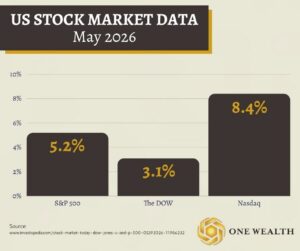
For the month, the market’s three major indices performed as follows:
S&P 500 5.2%
The Dow 3.1%
Nasdaq Composite 8.4%
The S&P 500 closed out May at a record 7,580.06. The benchmark index also recorded its ninth consecutive weekly gain, reflecting broad investor confidence and sustained market momentum.
Technology stocks led the market’s advance, particularly companies benefiting from growing demand for artificial intelligence infrastructure. So it’s no surprise that the tech-heavy Nasdaq Composite finished at a record 26,972.62, significantly outperforming the other major indexes.
The Dow Jones Industrial Average also reached a historic milestone, crossing the 51,000 mark for the first time. The blue-chip index ended May at 51,032.46, posting a gain of approximately 3.1% for the month.
Investor sentiment received an additional boost from geopolitical developments after U.S. and Iranian negotiators agreed to a 60-day memorandum of understanding to extend a ceasefire. Combined with softer-than-expected inflation data and declining crude oil prices, the agreement helped support risk assets and contributed to the record-setting finish for U.S. stocks.
Sources:
https://www.cnbc.com/2026/05/28/stock-market-today-live-updates.html
https://www.investopedia.com/stock-market-today-dow-jones-s-and-p-500-05292026-11986232
Fed Chair Powell steps down
Jerome Powell’s eight-year tenure as Federal Reserve Chair ended last month after steering the U.S. economy through some of the most turbulent periods in modern history — including the COVID-19 pandemic, the highest inflation in 40 years, and even a federal criminal investigation tied to the Fed.
First appointed in 2018, Powell initially raised rates to prepare for a future slowdown, then rapidly slashed them to near zero when the pandemic shut down the economy and unemployment surged to nearly 15%. Combined with massive government stimulus, the Fed’s actions helped fuel one of the fastest economic recoveries on record.
Powell’s biggest challenge — and likely defining legacy — came afterward, when inflation surged and the Fed was criticized for initially dismissing it as “transitory.” Powell later reversed course and led one of the most aggressive rate-hiking campaigns in decades, pushing borrowing costs to their highest levels since 2001. While the strategy successfully brought inflation down sharply without triggering the widely predicted recession, many Americans continued to feel squeezed by higher prices.
Powell will remain on the Fed’s board temporarily as incoming Chair Kevin Warsh prepares to take over amid renewed inflation concerns and ongoing questions about the Fed’s independence.
Source:
https://abcnews.com/Business/takeaways-fed-chair-jerome-powells-tenure-steps/story?id=132918698
Inflation
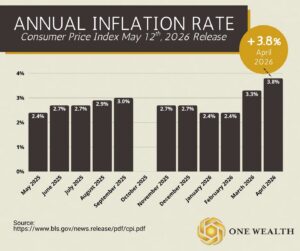
Inflation accelerated in April, with the Consumer Price Index (CPI) rising 0.6% for the month and 3.8% over the past 12 months, according to the U.S. Bureau of Labor Statistics. Core inflation, which excludes food and energy, rose 0.4% in April and 2.8% over the past year.
Much of the increase was driven by higher energy costs, as the energy index climbed 3.8% in April alone and is now up 17.9% year-over-year. Shelter costs also remained elevated, rising 0.6% for the month, while food prices increased 0.5%, reflecting ongoing pressure on household budgets.
The recent surge in inflation has been heavily influenced by rising oil prices tied to the ongoing conflict involving Iran. Brent crude oil prices jumped from roughly $70 per barrel before the conflict to as high as $118 in April, driving up gasoline, airfare, and transportation-related costs across the economy. Gasoline prices have risen about 28.4% over the past year, while airline fares increased 20.7%, illustrating how higher energy prices continue to ripple through many areas of consumer spending.
Economists warn that inflationary pressures may persist if global energy markets remain unstable. Continued disruptions in the Strait of Hormuz – a key shipping route for global oil supplies – have kept fuel prices elevated, creating additional strain for consumers already dealing with higher everyday expenses.
Sources:
https://www.bls.gov/news.release/cpi.nr0.htm
https://www.cnbc.com/2026/05/12/inflation-breakdown-for-april-2026-cpi-chart.html
Jobs & Unemployment
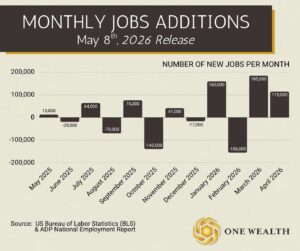
The U.S. labor market continued to show resilience in April as nonfarm payrolls increased by 115,000 jobs, beating economist expectations, while the unemployment rate held steady at 4.3%. Job growth was led by gains in healthcare, transportation and warehousing, and retail trade, although federal government employment continued to decline. The Bureau of Labor Statistics also reported that labor force participation remained unchanged at 61.8%, while the number of people working part-time for economic reasons rose to 4.9 million.
Despite concerns surrounding rising energy costs and global uncertainty tied to the Iran conflict, the labor market has so far remained stable. Economists noted that the latest report showed “no signs of a downturn just yet,” with the economy continuing to add jobs at a modest but steady pace. However, some warning signs remain, including weak consumer sentiment and fears that higher inflation and slowing demand could eventually pressure hiring activity later this year.
Sources:
https://www.bls.gov/news.release/pdf/empsit.pdf
https://www.ft.com/content/245e5c30-0a0b-43cd-b4b5-13f023c0b42d?syn-25a6b1a6=1
GDP
U.S. economic growth rebounded in the first quarter of 2026, with real GDP rising at a 2.0% annualized rate, according to the U.S. Bureau of Economic Analysis. This marks a strong improvement from 0.5% growth in Q4 2025 and a reversal from the 0.5% contraction in Q1 2025. Growth was driven by increases in investment, exports, and government spending, while consumer spending grew at a slower pace. Core demand remained solid, with real final sales to private domestic purchasers increasing 2.5%.
Inflation, however, remains a concern. The PCE price index rose 4.5% in Q1 (up from 2.9%), with core PCE at 4.3%. Rising energy prices—driven in part by geopolitical tensions—pushed March CPI to 3.3%, including a 21.2% surge in gasoline. Despite these pressures, Jerome Powell noted the economy remains “quite resilient,” supported by steady consumer activity and continued investment, particularly in AI and infrastructure.
Sources:
https://www.bea.gov/news/2026/gdp-advance-estimate-1st-quarter-2026
https://www.usatoday.com/story/money/2026/04/30/us-gdp-growth-q1-2026/89864094007/
Real Estate & Mortgage Market
The U.S. housing market showed continued signs of strain during April 2026 as elevated mortgage rates and affordability challenges weighed on buyers during what is traditionally the busiest home-buying season of the year. Existing home sales fell 3.6% in March to an annualized pace of 3.98 million homes — the lowest level in nine months — while the National Association of Realtors revised its 2026 housing outlook lower due to weaker consumer confidence and slowing economic momentum.
Mortgage rates remained volatile throughout April. The average 30-year fixed mortgage climbed as high as 6.57% in early April before easing slightly to around 6.23% later in the month, according to Freddie Mac. Reuters reported that rates had briefly dipped below 6% in February before geopolitical tensions, rising Treasury yields, and inflation concerns pushed borrowing costs higher again. Despite affordability pressures, housing inventory and pending home sales showed modest improvement late in the month, suggesting some buyers are cautiously returning to the market.
Sources:
https://www.reuters.com/business/us-existing-home-sales-drop-nine-month-low-march-amid-tight-supply-2026-04-13/
https://www.axios.com/2026/04/13/housing-mortgages-march-nar
https://www.reuters.com/business/finance/us-fixed-30-year-mortgage-rate-drops-623-2026-04-23
Notable Quote
“The central task of portfolio management is reducing the reliance on forecasting.”
-David Swenson, Yale CIO