


Stock Market
March 2026 proved to be a challenging and volatile month for U.S. equity markets, marking the weakest monthly performance since 2022. Investor sentiment deteriorated sharply as geopolitical tensions escalated in the Middle East, particularly involving Iran, which drove oil prices above $100 per barrel and reignited inflation concerns.
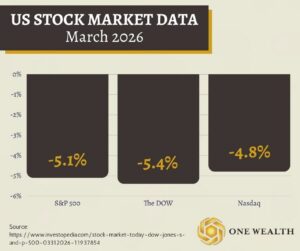
Against this backdrop, the market’s three major indexes performed as follows:
S&P 500 -5.1%
The Dow -5.4%
Nasdaq -4.8%
In March, the Dow Jones Industrial Average snapped a 10-month winning streak, and it was the S&P 500’s worst month since 2022.
Losses were broad-based, pushing markets well below recent highs and contributing to a negative first quarter overall.
Market movement throughout the month was largely dictated by external catalysts rather than underlying fundamentals. Energy stocks were a notable exception, benefiting from rising crude prices, while growth-oriented sectors – especially technology – experienced heightened volatility.
While markets staged a late-month rebound on hopes of de-escalation in the Iran conflict, it was not enough to offset earlier declines, leaving March firmly in negative territory and underscoring the market’s sensitivity to geopolitical and macroeconomic risks.
Sources:
https://www.cnbc.com/2026/03/30/stock-market-today-live-updates.html#:~:text=The%20Nasdaq%20remains%20more%20than,and%20the%20Dow%20dropped%203.6%25.
https://www.investopedia.com/stock-market-today-dow-jones-s-and-p-500-03312026-11937854
Inflation
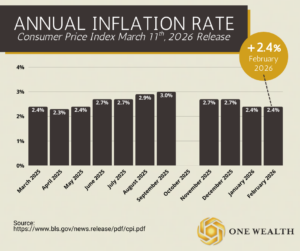
The Consumer Price Index (CPI) increased 0.3% in February on a seasonally adjusted basis, following a 0.2% increase in January, according to the U.S. Bureau of Labor Statistics. Over the past 12 months, inflation rose 2.4%, unchanged from the prior month.
The core CPI, which excludes food and energy, rose 0.2% in February and 2.5% year-over-year, both in line with expectations.
Several key categories contributed to the monthly increase. Shelter prices rose 0.2%, remaining the largest contributor to the overall CPI increase, while food prices climbed 0.4% for the month and are up 3.1% over the past year. Energy prices increased 0.6% in February and are up 0.5% year-over-year.
Sources:
https://www.cnbc.com/2026/03/11/cpi-inflation-report-february-2026.html
https://www.bls.gov/news.release/cpi.nr0.htm
Job Growth
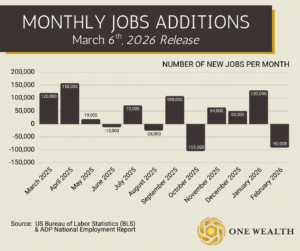
The U.S. labor market showed some softness in February, as nonfarm payrolls declined by 92,000 jobs, according to the Bureau of Labor Statistics. The figure came in below expectations for a modest increase and marked the third monthly decline in payrolls over the past five months.
The unemployment rate edged up slightly to 4.4%, with about 7.6 million Americans unemployed, though most demographic unemployment rates changed little during the month.
Several sectors experienced job losses, including health care, manufacturing, information services, transportation, construction, and federal government employment. Much of the decline in health care was attributed to a large Kaiser Permanente strike, while severe winter weather likely impacted construction and other industries.
Sources:
https://www.bls.gov/news.release/pdf/empsit.pdf
https://www.cnbc.com/2026/03/06/february-2026-jobs-report.html
GDP
U.S. economic growth slowed in the fourth quarter of 2025, with real gross domestic product (GDP) increasing at an annualized rate of 1.4%, according to the Bureau of Economic Analysis. This was down from the 4.4% growth rate in the third quarter and below economists’ expectations.
Consumer spending and private investment continued to support growth, but these gains were partly offset by declines in government spending and exports. A government shutdown during October and November is estimated to have reduced GDP growth by roughly 1 percentage point during the quarter.
For the full year, the U.S. economy grew 2.2% in 2025, compared with 2.8% growth in 2024.
Sources:
https://www.bea.gov/news/2026/gdp-advance-estimate-4th-quarter-and-year-2025
https://www.cnbc.com/2026/02/20/pce-inflation-december-2025.html
One Process with One Wealth
At One Wealth, we recognize that your goals are unique. While we follow our well-defined process to help you identify and reach your goals, our solutions are always custom-made.
We aim to protect your future so you can live fully in the moment.
Analyze
It all starts with asking the right questions: What do you value most? How do you imagine your future? And how does it differ from today? This helps us understand your objectives as we work together to craft your vision.
Customize
Here, we’ll help determine the best course of action and provide you with tailored strategies to help you get on track.
Implement
We remain committed to consistent communication throughout the entire implementation process.
Protect
Through regular updates and guidance, we’ll keep your longevity in mind and constantly review your financial situation to help protect your future.
Real Estate & Mortgage Market
The U.S. housing and mortgage market has shown modest signs of improvement in early 2026 as borrowing costs begin to ease. The average rate on a 30-year fixed mortgage recently dipped below 6% for the first time since September 2022, reaching about 5.98%, before hovering around the 6% level in recent weeks. This represents a meaningful decline from roughly 6.6% a year ago and well below the peaks above 7% seen in recent years.
At the same time, the housing market remains constrained by limited inventory and still-elevated home prices. According to the National Association of REALTORS®, existing-home sales are currently running at an annual pace of about 3.91 million units, with the median existing-home price around $396,800, up roughly 0.9% from a year ago. Inventory remains tight at roughly 3.7 months of supply, which continues to support prices even as affordability challenges persist.
Looking ahead, industry forecasts suggest conditions could gradually improve if borrowing costs stabilize near current levels.
While affordability remains a challenge for many buyers, slightly lower mortgage rates and a modest increase in inventory may help unlock activity in the housing market after several years of sluggish sales.
Sources:
https://eu.usatoday.com/story/money/personalfinance/real-estate/2026/02/26/mortgage-rates-fall-below-6-percent/88880904007/
https://www.nar.realtor/research-and-statistics
Notable Quote:
“Investing isn’t about beating others at their game. It’s about controlling yourself at your own game.”
-Benjamin Graham