


Stock Market
U.S. stocks declined in February as technology and AI shares continued to lose momentum. On Friday, February 27th – the last trading day of the month – the Dow fell 521 points (1.1%), the S&P 500 dropped 0.4%, and the Nasdaq slid 0.9%, marking one of the market’s few losing months in the past 10.
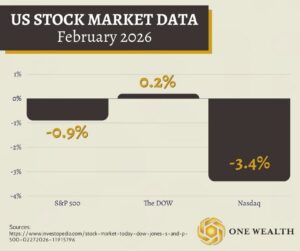
For the month, the market’s three main indices performed as follows:
S&P500 -0.9%
The DOW +0.2%
Nasdaq -3.4%
It was the Nasdaq’s worth monthly performance since March 2025 and its third negative month in the past four.
The Nasdaq Composite remains below its record high from four months ago and is down roughly 2.5% this year, while the S&P 500 is up 0.49% and the Dow Jones Industrial Average has gained 1.9% in 2026.
Sources:
https://www.cnbc.com/2026/02/26/stock-market-today-live-updates.html
https://www.investopedia.com/stock-market-today-dow-jones-s-and-p-500-02272026-11915796
https://edition.cnn.com/2026/02/27/investing/tech-stocks-us-markets
Inflation
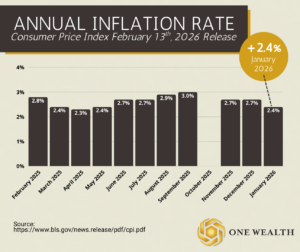
January inflation data showed continued signs of easing price pressures. The Consumer Price Index (CPI) rose 0.2% in January and was up 2.4% over the past 12 months, down from 2.7% in December and the lowest annual rate since May 2025.
Core CPI, which excludes food and energy, increased 0.3% for the month and 2.5% year over year — the lowest level since April 2021 and in line with expectations. Shelter costs rose 0.2% in January (3% annually), while food prices increased 0.2% and energy declined 1.5% for the month. Over the past year, food prices are up 2.9%, while energy is down 0.1%.
Shelter, which makes up more than one-third of the CPI calculation, remains a key driver but is moderating. Overall, goods and services prices rose at a slower pace than anticipated, helping reinforce the view that inflation pressures may be gradually cooling.
While inflation remains above the Fed’s 2% target, the latest data supports expectations that policymakers could begin easing later this year as price pressures trend closer to target levels.
Sources:
https://www.cnbc.com/2026/02/13/cpi-inflation-report-january-2026.html
https://www.bls.gov/news.release/cpi.nr0.htm
The Fed and Rates
In its January meeting, the Federal Reserve opted to keep the federal funds rate unchanged in the 3.50%–3.75% range, pausing the rate-cut cycle after multiple reductions in late 2025 as policymakers assess incoming economic data and inflation trends.
The committee noted signs of stabilization in the labor market and persistent but moderating inflation, emphasizing that future policy adjustments will be “data-dependent,” with neither cuts nor hikes pre-committed. Strategists now expect the Fed to maintain this cautious stance through most of 2026, with markets pricing limited near-term action and possible revisions later in the year depending on inflation and employment outcomes.
Source:
https://www.jpmorgan.com/insights/markets-and-economy/economy/fed-meeting-january-2026
Jobs & Unemployment
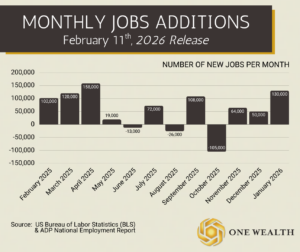
U.S. job growth came in stronger than expected to start 2026, with total nonfarm payrolls rising by 130,000 in January, well above the Dow Jones consensus estimate of 55,000 and up from a revised 48,000 gain in December.
Health care once again led job creation with 82,000 new positions, followed by social assistance (+42,000) and construction (+33,000). However, federal government employment fell by 34,000 and financial activities declined by 22,000.
The unemployment rate edged down to 4.3%, slightly better than forecasts for 4.4%, though still higher than a year ago when it stood at 4.0%.
Overall, the report reflects a labor market that remains in a low-growth, stabilizing phase, with job gains concentrated in a few sectors and only modest shifts in broader employment measures.
Sources:
https://www.cnbc.com/2026/02/11/jobs-report-january-2026-.html
https://www.bls.gov/news.release/pdf/empsit.pdf
Interesting financial facts
In 1792, in the aftermath of the Panic of 1792—America’s first major financial crisis—24 New York brokers met under a buttonwood tree outside what is now 68 Wall Street to bring order to a chaotic and often corrupt trading environment.
Speculation, scams, and unregulated deals had shaken confidence, prompting these men to sign the simple two-sentence “Buttonwood Agreement” on May 17, 1792.
They agreed to trade securities primarily with one another and to charge a fixed 0.25% commission, creating structure, accountability, and trust during a time of market fear.
That informal pact laid the foundation for what eventually became the New York Stock Exchange—an enduring reminder that some of the world’s most important financial institutions are born not in times of prosperity, but in moments of uncertainty and crisis.
Source:
https://www.thewallstreetexperience.com/blog/meet-the-famous-buttonwood-tree-of-wall-street/
Real Estate & Mortgage Market
U.S. 30-year fixed mortgage rates recently dipped below 6% – averaging about 5.99% – marking the lowest levels seen since 2022. This represents more than a full percentage point drop compared with the same time last year (around 6.89%) and reflects easing borrowing costs after a period of elevated rates above 7%.
While this decline doesn’t signal a return to the historically low rates of the early 2020s, it does improve affordability modestly and is boosting refinancing activity. Lower rates also increase purchasing power, potentially qualifying millions more households for mortgages compared with a year ago, even as housing inventory remains tight and pending sales have been mixed.
Nationally, existing-home sales continued to soften early in 2026, with January figures showing an 8.4% month-over-month decline and a 4.4% year-over-year drop in transactions, settling at a 3.91 million annualized sales pace. Despite the slowdown, median existing-home prices still rose modestly, reaching about $396,800 — the 31st consecutive month of annual price increases. Inventory remains tight, with roughly a 3.7-month supply, while the housing affordability index improved as mortgage rates eased from 2025 highs.
Sources:
https://www.cnbc.com/2026/02/23/mortgage-rates-below-6percent-lowest-in-4-years.html
https://www.nar.realtor/newsroom/nar-existing-home-sales-report-shows-8-4-decrease-in-january
Notable Quote
“The goal isn’t inactivity – it’s intentional activity guided by a plan – not impulse.”
-Unknown