
Stock Market
U.S. stock markets delivered mixed results in September, as rising Treasury yields, persistent inflation concerns, and uncertainty surrounding Federal Reserve interest rate policy weighed on investors. Technology and artificial intelligence stocks remained a bright spot, helping the Nasdaq outperform the broader market despite a challenging month for equities.
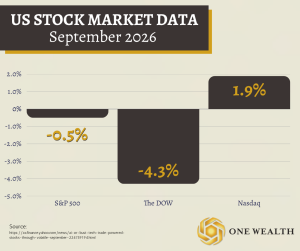
For the month, the market’s three major indices performed as follows:
S&P 500: −0.5%
Dow Jones Industrial Average: −4.3%
Nasdaq Composite: +1.9%
September marked the end of the Dow’s five-month winning streak, while the S&P 500 recorded its third monthly decline in four months. The Nasdaq posted its second consecutive monthly gain, supported by continued strength in technology stocks. Despite September’s mixed performance, both the S&P 500 and Nasdaq finished the third quarter with gains.
Sources:
https://www.reuters.com/business/us-stock-futures-inch-up-yields-ease-inflation-report-looms-2026-09-30/
https://ca.finance.yahoo.com/news/ai-or-bust-tech-trade-powered-stocks-through-volatile-september-224759194.html
Inflation
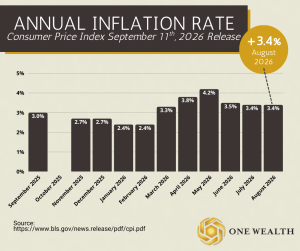
Inflation remained elevated in August, with the Consumer Price Index rising 0.4% for the month and 3.4% over the past 12 months. Core inflation, which excludes food and energy, increased 0.3% in August and 2.4% year over year. Energy was a major contributor to the latest increase: gasoline prices rose 3.9% during the month and accounted for more than one-third of the overall monthly CPI increase.
The recent rise in energy costs is becoming an important part of the inflation story. Gasoline prices were more than 27% higher than a year earlier, while airfare increased nearly 3% in August and more than 23% year over year. Higher diesel, jet fuel and transportation costs also have the potential to work their way through supply chains, increasing the cost of moving food and other goods.
With inflation still running above the Federal Reserve’s 2% target, economists see increased pressure on policymakers to keep monetary policy restrictive or potentially raise rates if price pressures persist.
Sources:
https://www.bls.gov/news.release/cpi.nr0.htm
https://www.cnbc.com/2026/09/11/cpi-inflation-breakdown-august-2026.html
Jobs & Unemployment
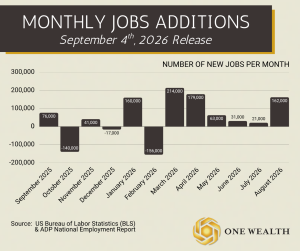
The U.S. labor market delivered a stronger-than-expected performance in August, with total nonfarm payroll employment increasing by 162,000 jobs, well above economists’ expectations for a gain of 55,000. The unemployment rate remained unchanged at 4.1%, with approximately 7.0 million people unemployed. Job growth was led by food services and drinking places, which added 59,000 positions, and local government education, which gained 42,000 jobs. Healthcare employment increased by 13,000, while the information sector lost 23,000 positions.
Other measures painted a relatively stable picture of the labor market. The labor force participation rate edged up to 61.6%, although it remains 0.5 percentage point below its January level. The number of people working part time for economic reasons declined by 414,000 to 4.4 million, while long-term unemployment remained little changed at 1.9 million, representing 27.0% of all unemployed workers. Average hourly earnings increased 0.3% in August and were up 3.1% from a year earlier.
Sources:
https://www.bls.gov/news.release/pdf/empsit.pdf
https://finance.yahoo.com/economy/article/us-added-162000-jobs-in-august-smashing-expectations-jobs-report
Real Estate & Mortgage Market
According to the National Association of Realtors’ existing-home sales report, existing-home sales dropped 2.0% month-over-month to a seasonally adjusted annual rate of 3.98 million units. Unsold inventory expanded 3.2% to 1.62 million units, pushing national housing supply to 4.9 months — the highest level in over a decade, up from 4.6 months in July and 4.6 months in August 2025. Separately, Redfin’s market report found that 59.5% of homes sold below their original asking price in August, with total homes for sale climbing 3.9% month-over-month to 1,534,918.
Following the Federal Reserve’s quarter-point rate hike on September 17, 2026, mortgage rates were reported hovering around 7.2%, according to Mortgage News Daily, after touching as high as 7.24% in the weeks prior — the highest level since early 2025. Freddie Mac’s weekly survey showed the 30-year fixed-rate mortgage averaging 6.95% for the week through September 17, up sharply from 6.76% the prior week. The 10-year Treasury yield, which mortgage rates closely track, dipped 6 basis points to 4.94% as investors priced in the view that the Fed may be starting a new rate-hiking cycle to address persistently high inflation.
Source:
https://finance.yahoo.com/personal-finance/mortgages/article/mortgage-rates-fell-slightly-after-the-fed-hiked-rates-mortgage-and-refinance-interest-rates-today-thursday-september-17-2026-100000901.html
Interest Rates and the Fed
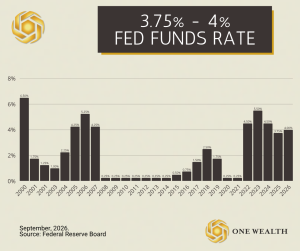
The Federal Reserve raised its benchmark interest rate by 25 basis points on September 16, 2026, bringing the target range to 3.75%–4% – its first rate hike since 2023.
The Federal Open Market Committee approved the move by a unanimous 12–0 vote, citing continued elevated inflation and a resilient labor market. In its statement, the Committee said inflation “remains elevated” and that the rate action “will support a timelier return to the Committee’s 2 percent goal.” Fed Chairman Kevin Warsh said inflation had been “too high … for too long” and pointed to strong labor market data along with tensions in the Middle East as factors behind the decision.
Updated Fed projections show 16 of 18 committee officials expect at least one more rate hike this year, with four anticipating two more increases; two officials expect the Fed to hold at this single hike.
Sources:
https://www.federalreserve.gov/newsevents/pressreleases/monetary20260916a.htm
https://www.cnbc.com/2026/09/16/fed-rate-decision-september-2026.html
Notable Quote
“The most important key to successful investing is to have a plan. You must know where you are and where you want to go.”
-David Swensen


Stock Market
U.S. stock markets delivered mixed results in September, as rising Treasury yields, persistent inflation concerns, and uncertainty surrounding Federal Reserve interest rate policy weighed on investors. Technology and artificial intelligence stocks remained a bright spot, helping the Nasdaq outperform the broader market despite a challenging month for equities.
For the month, the market’s three major indices performed as follows:
S&P 500: −0.5%
Dow Jones Industrial Average: −4.3%
Nasdaq Composite: +1.9%
September marked the end of the Dow’s five-month winning streak, while the S&P 500 recorded its third monthly decline in four months. The Nasdaq posted its second consecutive monthly gain, supported by continued strength in technology stocks. Despite September’s mixed performance, both the S&P 500 and Nasdaq finished the third quarter with gains.
Sources:
https://www.reuters.com/business/us-stock-futures-inch-up-yields-ease-inflation-report-looms-2026-09-30/
https://ca.finance.yahoo.com/news/ai-or-bust-tech-trade-powered-stocks-through-volatile-september-224759194.html
Inflation
Inflation remained elevated in August, with the Consumer Price Index rising 0.4% for the month and 3.4% over the past 12 months. Core inflation, which excludes food and energy, increased 0.3% in August and 2.4% year over year. Energy was a major contributor to the latest increase: gasoline prices rose 3.9% during the month and accounted for more than one-third of the overall monthly CPI increase.
The recent rise in energy costs is becoming an important part of the inflation story. Gasoline prices were more than 27% higher than a year earlier, while airfare increased nearly 3% in August and more than 23% year over year. Higher diesel, jet fuel and transportation costs also have the potential to work their way through supply chains, increasing the cost of moving food and other goods.
With inflation still running above the Federal Reserve’s 2% target, economists see increased pressure on policymakers to keep monetary policy restrictive or potentially raise rates if price pressures persist.
Sources:
https://www.bls.gov/news.release/cpi.nr0.htm
https://www.cnbc.com/2026/09/11/cpi-inflation-breakdown-august-2026.html
Jobs & Unemployment
The U.S. labor market delivered a stronger-than-expected performance in August, with total nonfarm payroll employment increasing by 162,000 jobs, well above economists’ expectations for a gain of 55,000. The unemployment rate remained unchanged at 4.1%, with approximately 7.0 million people unemployed. Job growth was led by food services and drinking places, which added 59,000 positions, and local government education, which gained 42,000 jobs. Healthcare employment increased by 13,000, while the information sector lost 23,000 positions.
Other measures painted a relatively stable picture of the labor market. The labor force participation rate edged up to 61.6%, although it remains 0.5 percentage point below its January level. The number of people working part time for economic reasons declined by 414,000 to 4.4 million, while long-term unemployment remained little changed at 1.9 million, representing 27.0% of all unemployed workers. Average hourly earnings increased 0.3% in August and were up 3.1% from a year earlier.
Sources:
https://www.bls.gov/news.release/pdf/empsit.pdf
https://finance.yahoo.com/economy/article/us-added-162000-jobs-in-august-smashing-expectations-jobs-report
Real Estate & Mortgage Market
According to the National Association of Realtors’ existing-home sales report, existing-home sales dropped 2.0% month-over-month to a seasonally adjusted annual rate of 3.98 million units. Unsold inventory expanded 3.2% to 1.62 million units, pushing national housing supply to 4.9 months — the highest level in over a decade, up from 4.6 months in July and 4.6 months in August 2025. Separately, Redfin’s market report found that 59.5% of homes sold below their original asking price in August, with total homes for sale climbing 3.9% month-over-month to 1,534,918.
Following the Federal Reserve’s quarter-point rate hike on September 17, 2026, mortgage rates were reported hovering around 7.2%, according to Mortgage News Daily, after touching as high as 7.24% in the weeks prior — the highest level since early 2025. Freddie Mac’s weekly survey showed the 30-year fixed-rate mortgage averaging 6.95% for the week through September 17, up sharply from 6.76% the prior week. The 10-year Treasury yield, which mortgage rates closely track, dipped 6 basis points to 4.94% as investors priced in the view that the Fed may be starting a new rate-hiking cycle to address persistently high inflation.
Source:
https://finance.yahoo.com/personal-finance/mortgages/article/mortgage-rates-fell-slightly-after-the-fed-hiked-rates-mortgage-and-refinance-interest-rates-today-thursday-september-17-2026-100000901.html
Interest Rates and the Fed
The Federal Reserve raised its benchmark interest rate by 25 basis points on September 16, 2026, bringing the target range to 3.75%–4% – its first rate hike since 2023.
The Federal Open Market Committee approved the move by a unanimous 12–0 vote, citing continued elevated inflation and a resilient labor market. In its statement, the Committee said inflation “remains elevated” and that the rate action “will support a timelier return to the Committee’s 2 percent goal.” Fed Chairman Kevin Warsh said inflation had been “too high … for too long” and pointed to strong labor market data along with tensions in the Middle East as factors behind the decision.
Updated Fed projections show 16 of 18 committee officials expect at least one more rate hike this year, with four anticipating two more increases; two officials expect the Fed to hold at this single hike.
Sources:
https://www.federalreserve.gov/newsevents/pressreleases/monetary20260916a.htm
https://www.cnbc.com/2026/09/16/fed-rate-decision-september-2026.html
Notable Quote
“The most important key to successful investing is to have a plan. You must know where you are and where you want to go.”
-David Swensen