Stock Market
U.S. stocks closed out October with a sharp sell-off on Friday as disappointing tech earnings deepened worries about artificial intelligence spending. The Nasdaq posted its largest one-day percentage drop since June 5 and has now fallen 7.8% from its all-time closing high on October 6. Intel shares fell nearly 29%, the chipmaker’s biggest single day drop since 1974.
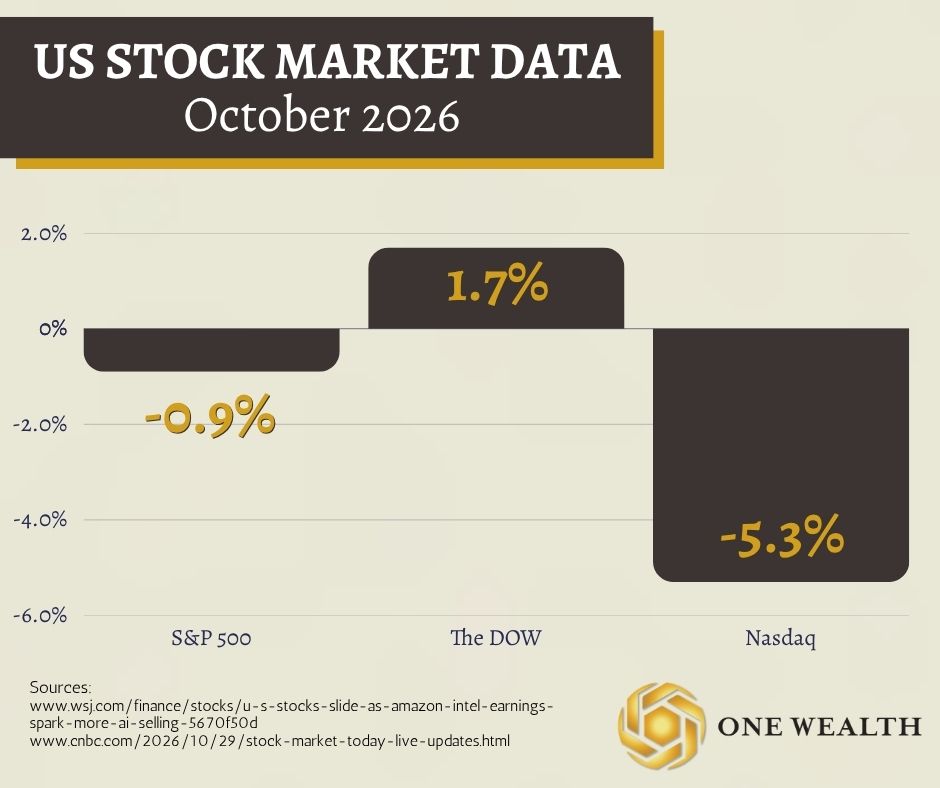
For the month, Wall Street’s three major indices performed as follows:
S&P 500: -0.9%
Dow: +1.7%
Nasdaq: -5.3%
The Nasdaq Composite posted its steepest monthly decline since March 2025. Analysts attributed the sell-off to growing concern that big tech companies’ heavy AI spending, combined with rising financing costs, may take longer to turn into profits. Recent earnings reports added to those worries by showing slower growth in some of the largest tech companies’ core businesses.
Sources:
https://www.wsj.com/finance/stocks/u-s-stocks-slide-as-amazon-intel-earnings-spark-more-ai-selling-5670f50d
https://www.cnbc.com/2026/10/29/stock-market-today-live-updates.html
Inflation
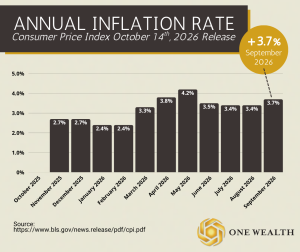
Inflation accelerated in September, with the Consumer Price Index (CPI) rising 0.6% for the month and 3.7% over the past year, up from 3.4% in August.
Higher energy costs were the biggest driver, with gasoline prices surging 9.1% in September alone. However, inflationary pressures extended beyond energy, with increases in housing, vehicle prices, healthcare, and apparel. Core inflation, which excludes food and energy, rose to 2.6% annually, suggesting that price pressures remain persistent throughout the economy.
With inflation continuing to run above the Federal Reserve’s 2% target, policymakers face renewed pressure to keep interest rates elevated or consider additional increases. Higher borrowing costs could affect everything from mortgages and consumer spending to business investment and financial markets.
Sources:
https://www.bls.gov/news.release/cpi.nr0.htm
https://www.cnbc.com/2026/10/14/cpi-inflation-report-september-2026.html
Jobs & Unemployment
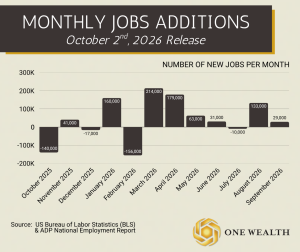
The U.S. labor market showed signs of slowing in September, with nonfarm payrolls increasing by just 29,000 jobs, well below economists’ forecast of 84,000.
The unemployment rate stood at 4.2%, with approximately 7.1 million people unemployed, remaining within its narrow 4.1%–4.3% range since March.
Job growth was concentrated in health care (+17,000), construction (+11,000) and manufacturing (+9,000), while government employment declined by 17,000.
Other indicators point to a relatively stable but increasingly challenging job market. However, wage growth weakened: average hourly earnings rose just 0.1% in September and 3.0% year over year, the lowest annual growth rate since May 2021.
Overall, the data suggest a low hiring labor market, with limited job creation and moderating wage growth despite relatively little change in the headline unemployment rate.
Sources:
https://www.bls.gov/news.release/pdf/empsit.pdf
https://www.cnbc.com/2026/10/02/jobs-report-september-2026.html
GDP
The U.S. economy continued to demonstrate resilience heading into October, with the latest official GDP figures showing 2.2% annualized growth in the second quarter of 2026, following 2.5% growth in the first quarter. Consumer spending, business investment, and exports helped support economic activity, although growth moderated slightly. These figures suggest the economy continued expanding despite ongoing inflation concerns and elevated borrowing costs.
Looking ahead, the Federal Reserve Bank of Atlanta’s GDPNow model estimated 3.5% annualized GDP growth for the third quarter, as of October 20. While this is a preliminary estimate rather than an official GDP reading, it suggests economic growth may have accelerated during the summer months. The government’s first official third-quarter GDP estimate is scheduled for October 29 and will provide a clearer picture of the economy’s momentum heading into the final months of 2026.
Sources:
https://www.bea.gov/data/gdp/gross-domestic-product
https://www.atlantafed.org/research-and-data/data/gdpnow
Real Estate & Mortgage Market
The U.S. housing market continued to show signs of cooling in October, with elevated mortgage rates limiting buyer demand even as housing inventory increased. According to Realtor.com, the national median asking price was approximately $415,000 in mid-October, down 2.1% from a year earlier, while active listings increased 7.7%.
Meanwhile, the National Association of Realtors reported that the median existing-home sale price reached $417,500 in September, up 1.3% year over year. Existing-home sales rose 1.5% from August but remained 2.2% below September 2025 levels, highlighting continued affordability challenges.
Mortgage rates remained a major obstacle for prospective homebuyers. According to Freddie Mac, the average 30-year fixed mortgage rate stood at 7.32% as of October 22, down slightly from 7.40% the previous week but significantly higher than the 6.19% recorded a year earlier. The combination of high borrowing costs, rising inventory, and softer asking prices is gradually giving buyers more negotiating power, although affordability remains a significant concern.
Sources:
https://www.realtor.com/research/eekly-housing-trends-view-data-week-october-17-2026/
https://www.freddiemac.com/
The Fed and Rates
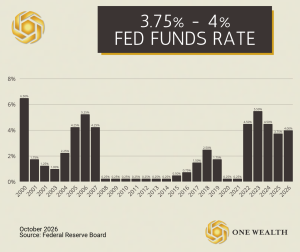
The Federal Reserve held its benchmark interest rate steady at 3.75%–4.00% during its October 28 meeting, citing persistent inflation despite continued economic strength. The decision passed by a 10–2 vote, with two policymakers favoring a quarter-percentage-point increase. The Fed noted resilient consumer spending, strong productivity growth, robust business investment, and a relatively stable labor market, while emphasizing that inflation remains above its 2% target.
The decision reflects the Fed’s cautious approach as it balances economic growth with the need to control inflation. Policymakers indicated that future rate decisions will depend on incoming economic data, leaving open the possibility of additional increases if inflation remains stubbornly elevated.
Sources:
https://www.federalreserve.gov/newsevents/pressreleases/monetary20261028a.htm
https://www.investing.com/news/economy-news/fed-holds-rates-steady-as-it-awaits-accumulation-of-more-information-4980411
Notable Quote
“To achieve satisfactory investment results is easier than most people realize; to achieve superior results is harder than it looks.”
-Benjamin Graham


Stock Market
U.S. stocks closed out October with a sharp sell-off on Friday as disappointing tech earnings deepened worries about artificial intelligence spending. The Nasdaq posted its largest one-day percentage drop since June 5 and has now fallen 7.8% from its all-time closing high on October 6. Intel shares fell nearly 29%, the chipmaker’s biggest single day drop since 1974.
For the month, Wall Street’s three major indices performed as follows:
S&P 500: -0.9%
Dow: +1.7%
Nasdaq: -5.3%
The Nasdaq Composite posted its steepest monthly decline since March 2025. Analysts attributed the sell-off to growing concern that big tech companies’ heavy AI spending, combined with rising financing costs, may take longer to turn into profits. Recent earnings reports added to those worries by showing slower growth in some of the largest tech companies’ core businesses.
Sources:
https://www.wsj.com/finance/stocks/u-s-stocks-slide-as-amazon-intel-earnings-spark-more-ai-selling-5670f50d
https://www.cnbc.com/2026/10/29/stock-market-today-live-updates.html
Inflation
Inflation accelerated in September, with the Consumer Price Index (CPI) rising 0.6% for the month and 3.7% over the past year, up from 3.4% in August.
Higher energy costs were the biggest driver, with gasoline prices surging 9.1% in September alone. However, inflationary pressures extended beyond energy, with increases in housing, vehicle prices, healthcare, and apparel. Core inflation, which excludes food and energy, rose to 2.6% annually, suggesting that price pressures remain persistent throughout the economy.
With inflation continuing to run above the Federal Reserve’s 2% target, policymakers face renewed pressure to keep interest rates elevated or consider additional increases. Higher borrowing costs could affect everything from mortgages and consumer spending to business investment and financial markets.
Sources:
https://www.bls.gov/news.release/cpi.nr0.htm
https://www.cnbc.com/2026/10/14/cpi-inflation-report-september-2026.html
Jobs & Unemployment
The U.S. labor market showed signs of slowing in September, with nonfarm payrolls increasing by just 29,000 jobs, well below economists’ forecast of 84,000.
The unemployment rate stood at 4.2%, with approximately 7.1 million people unemployed, remaining within its narrow 4.1%–4.3% range since March.
Job growth was concentrated in health care (+17,000), construction (+11,000) and manufacturing (+9,000), while government employment declined by 17,000.
Other indicators point to a relatively stable but increasingly challenging job market. However, wage growth weakened: average hourly earnings rose just 0.1% in September and 3.0% year over year, the lowest annual growth rate since May 2021.
Overall, the data suggest a low hiring labor market, with limited job creation and moderating wage growth despite relatively little change in the headline unemployment rate.
Sources:
https://www.bls.gov/news.release/pdf/empsit.pdf
https://www.cnbc.com/2026/10/02/jobs-report-september-2026.html
GDP
The U.S. economy continued to demonstrate resilience heading into October, with the latest official GDP figures showing 2.2% annualized growth in the second quarter of 2026, following 2.5% growth in the first quarter. Consumer spending, business investment, and exports helped support economic activity, although growth moderated slightly. These figures suggest the economy continued expanding despite ongoing inflation concerns and elevated borrowing costs.
Looking ahead, the Federal Reserve Bank of Atlanta’s GDPNow model estimated 3.5% annualized GDP growth for the third quarter, as of October 20. While this is a preliminary estimate rather than an official GDP reading, it suggests economic growth may have accelerated during the summer months. The government’s first official third-quarter GDP estimate is scheduled for October 29 and will provide a clearer picture of the economy’s momentum heading into the final months of 2026.
Sources:
https://www.bea.gov/data/gdp/gross-domestic-product
https://www.atlantafed.org/research-and-data/data/gdpnow
Real Estate & Mortgage Market
The U.S. housing market continued to show signs of cooling in October, with elevated mortgage rates limiting buyer demand even as housing inventory increased. According to Realtor.com, the national median asking price was approximately $415,000 in mid-October, down 2.1% from a year earlier, while active listings increased 7.7%.
Meanwhile, the National Association of Realtors reported that the median existing-home sale price reached $417,500 in September, up 1.3% year over year. Existing-home sales rose 1.5% from August but remained 2.2% below September 2025 levels, highlighting continued affordability challenges.
Mortgage rates remained a major obstacle for prospective homebuyers. According to Freddie Mac, the average 30-year fixed mortgage rate stood at 7.32% as of October 22, down slightly from 7.40% the previous week but significantly higher than the 6.19% recorded a year earlier. The combination of high borrowing costs, rising inventory, and softer asking prices is gradually giving buyers more negotiating power, although affordability remains a significant concern.
Sources:
https://www.realtor.com/research/eekly-housing-trends-view-data-week-october-17-2026/
https://www.freddiemac.com/
The Fed and Rates
The Federal Reserve held its benchmark interest rate steady at 3.75%–4.00% during its October 28 meeting, citing persistent inflation despite continued economic strength. The decision passed by a 10–2 vote, with two policymakers favoring a quarter-percentage-point increase. The Fed noted resilient consumer spending, strong productivity growth, robust business investment, and a relatively stable labor market, while emphasizing that inflation remains above its 2% target.
The decision reflects the Fed’s cautious approach as it balances economic growth with the need to control inflation. Policymakers indicated that future rate decisions will depend on incoming economic data, leaving open the possibility of additional increases if inflation remains stubbornly elevated.
Sources:
https://www.federalreserve.gov/newsevents/pressreleases/monetary20261028a.htm
https://www.investing.com/news/economy-news/fed-holds-rates-steady-as-it-awaits-accumulation-of-more-information-4980411
Notable Quote
“To achieve satisfactory investment results is easier than most people realize; to achieve superior results is harder than it looks.”
-Benjamin Graham