Stock Market
U.S. stocks finished August higher despite a volatile month shaped by shifting interest-rate expectations, geopolitical tensions, and elevated energy prices. Technology and AI-related stocks remained an important source of market strength, while solid corporate earnings helped support investor sentiment. The major indexes were able to advance even as investors weighed persistent inflation concerns and uncertainty surrounding the Federal Reserve’s next policy move.
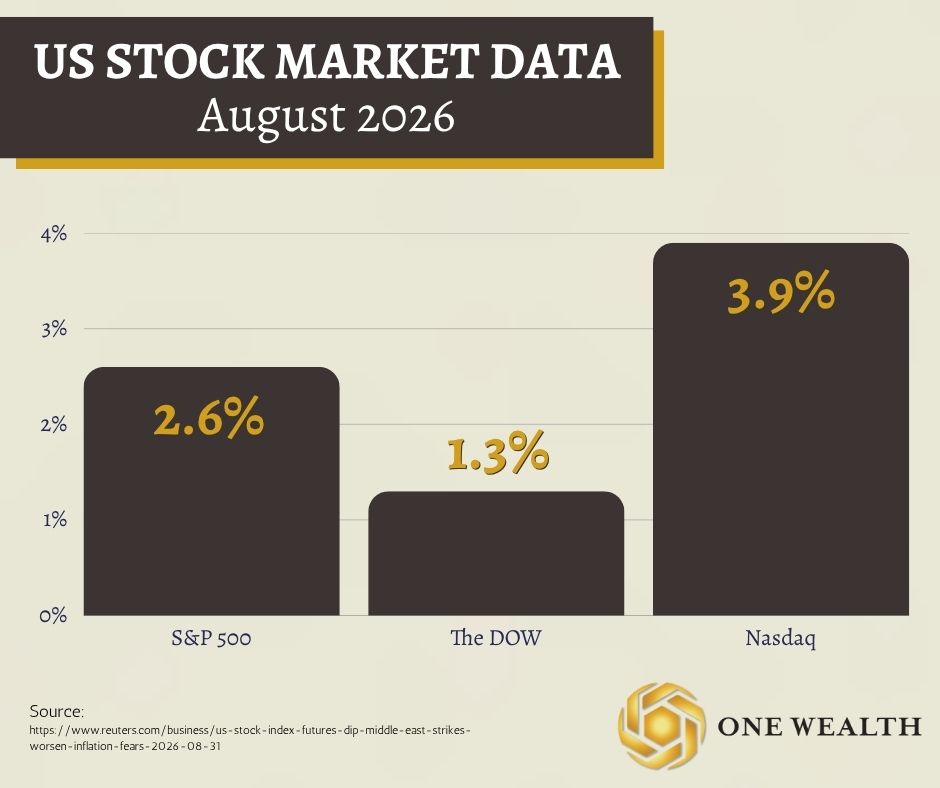
For the month of August, the market’s three major indices performed as follows:
S&P 500 2.6%
The Dow 1.3%
Nasdaq 3.9%
Sources:
https://www.reuters.com/business/us-stock-index-futures-dip-middle-east-strikes-worsen-inflation-fears-2026-08-31
https://www.marketwatch.com/livecoverage/stock-market-today-dow-s-p-500-and-nasdaq-set-to-fall-as-brent-oil-tops-90-after-u-s-strike-on-iran/card/stocks-logs-back-to-back-declines-but-still-book-august-gains-OukmStRiEZLZI9XyMuPu
Inflation
The latest inflation report offered some encouraging signs that price pressures are continuing to moderate.
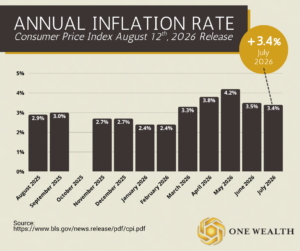
The Consumer Price Index (CPI) rose 0.1% in July, following a 0.4% decline in June, according to the U.S. Bureau of Labor Statistics. Over the past 12 months, consumer prices increased 3.4%, down slightly from the 3.5% annual rate reported in June.
Core CPI, which excludes the more volatile food and energy categories, increased 0.2% for the month and 2.5% over the past year, also easing from June’s 2.6% annual rate. The results were in line with Wall Street expectations.
Shelter costs increased just 0.1% in July, although they still accounted for roughly two-thirds of the overall monthly CPI increase. Food prices also rose 0.1%, while energy prices declined 1.5% for the month. Despite the monthly decline, energy costs remain 14.7% higher than a year ago, while food prices are up 3.0%.
Elsewhere, medical care costs increased 0.4%, airline fares rose 2.2%, new vehicle prices increased 0.1%, and used cars and trucks rose 0.4%.
While annual inflation remains above the Federal Reserve’s 2% target, the July report suggests that some of the inflationary pressure seen earlier in the year may be easing. Markets responded positively to the report, while expectations for a Federal Reserve rate increase in September declined.
Sources:
https://www.cnbc.com/2026/08/12/cpi-inflation-report-july-2026.html
https://www.bls.gov/news.release/cpi.nr0.htm
Jobs & Unemployment
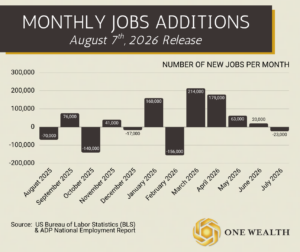
U.S. job growth stalled in July, with nonfarm payrolls declining by 23,000 jobs, according to the Bureau of Labor Statistics. The decline was driven in part by losses in local government education and retail trade, while health care continued to add jobs. Construction added 22,000 jobs and manufacturing gained 5,000.
The unemployment rate was 4.1%, while the number of unemployed Americans remained about 6.9 million. Labor force participation stood at 61.4%, down 0.7 percentage point since January, while the employment-population ratio was 58.9%. Long-term unemployment was approximately 1.8 million, representing 25.5% of all unemployed people.
Previous months were also revised substantially lower. May’s job gain was reduced from 129,000 to 63,000, while June was revised from 57,000 to just 20,000 — a combined downward revision of 103,000 jobs.
Sources:
https://www.bls.gov/news.release/pdf/empsit.pdf
https://apnews.com/article/economy-jobs-trump-unemployment-rate-jobseekers-9c2d147c14bc428458be5a1e83e54957
GDP
The U.S. economy grew at a 1.5% annual rate in the second quarter of 2026, slowing from 2.1% in the first quarter, according to the Bureau of Economic Analysis. Consumer spending provided an important source of strength, accelerating to a 3.4% annual rate, compared with just 0.5% in the first quarter. Business investment also remained robust, with nonresidential investment rising at an 8.5% pace, helped in part by continued spending on artificial intelligence infrastructure.
The headline GDP figure was weighed down considerably by a 12.5% surge in imports, which subtract from GDP because the measure counts domestic production. Imports reduced second-quarter growth by approximately 1.64 percentage points. Looking beyond volatile trade and government spending, real final sales to private domestic purchasers—a measure of consumer spending and private fixed investment—rose a strong 4.2%, up from 1.7% in the first quarter. Residential investment also increased for the first time since the end of 2024.
Sources:
https://www.bea.gov/news/2026/gdp-second-estimate-and-corporate-profits-2nd-quarter-2026
https://apnews.com/article/economic-growth-inflation-trump-trade-b6c975fb2624044ca7e537909cffb05e
Real Estate & Mortgage Market
The U.S. housing market continued to move at a restrained pace in July. Existing-home sales declined 1.7% from June, reaching a seasonally adjusted annual rate of 4.06 million, although sales remained 0.7% higher than a year earlier. Housing inventory totaled approximately 1.54 million homes, representing a 4.6-month supply.
Home prices remain elevated despite slower sales activity. The median existing-home sales price reached $431,400 in July, while higher borrowing costs continue to challenge affordability. Overall, the latest numbers point to a market where buyers in some areas may benefit from more choices and negotiating opportunities, but elevated prices and mortgage rates continue to limit demand.
Mortgage rates remain one of the biggest factors influencing today’s housing market. Mortgage News Daily reported the average 30-year fixed mortgage rate at 6.71% on August 14, up slightly from 6.69% the previous day. Despite the small increase, rates remained near their lowest levels in roughly four weeks.
Sources:
https://www.nar.realtor/newsroom/nar-existing-home-sales-report-shows-1-7-decrease-in-july
https://www.mortgagenewsdaily.com/markets/mortgage-rates-08142026
Is the rising cost of college still worth it?
The cost of a traditional four-year college education has risen dramatically, leading more families to question whether the potential return justifies the expense. Over the past four decades, college costs have increased far faster than earnings for young workers. While a college degree continues to provide value in many professions, today’s students have more viable alternatives than previous generations.
Online degree programs have become increasingly accepted, while coding bootcamps can provide specialized technology training in a matter of months rather than years. Vocational and associate-degree careers are also attracting renewed interest, with occupations such as air traffic controllers, nuclear technicians, elevator mechanics, radiation therapists and dental hygienists offering strong earning potential without requiring a traditional four-year degree.
For families committed to the traditional college route, planning ahead remains critical. Options such as 529 plans and the Private College 529 Plan can help families prepare for future tuition expenses. Ultimately, the decision should go beyond simply asking whether college is “worth it.” Families should weigh the total cost against a student’s career goals, expected earning potential and the growing number of alternative education and career paths available today.
Source:
https://www.crystalfunds.com/insights/college-tuition-costs-is-college-worth-it/
Notable Quote
“The essence of investment management is the management of risks, not the management of returns.”
-Benjamin Graham


Stock Market
U.S. stocks finished August higher despite a volatile month shaped by shifting interest-rate expectations, geopolitical tensions, and elevated energy prices. Technology and AI-related stocks remained an important source of market strength, while solid corporate earnings helped support investor sentiment. The major indexes were able to advance even as investors weighed persistent inflation concerns and uncertainty surrounding the Federal Reserve’s next policy move.
For the month of August, the market’s three major indices performed as follows:
S&P 500 2.6%
The Dow 1.3%
Nasdaq 3.9%
Sources:
https://www.reuters.com/business/us-stock-index-futures-dip-middle-east-strikes-worsen-inflation-fears-2026-08-31
https://www.marketwatch.com/livecoverage/stock-market-today-dow-s-p-500-and-nasdaq-set-to-fall-as-brent-oil-tops-90-after-u-s-strike-on-iran/card/stocks-logs-back-to-back-declines-but-still-book-august-gains-OukmStRiEZLZI9XyMuPu
Inflation
The latest inflation report offered some encouraging signs that price pressures are continuing to moderate.
The Consumer Price Index (CPI) rose 0.1% in July, following a 0.4% decline in June, according to the U.S. Bureau of Labor Statistics. Over the past 12 months, consumer prices increased 3.4%, down slightly from the 3.5% annual rate reported in June.
Core CPI, which excludes the more volatile food and energy categories, increased 0.2% for the month and 2.5% over the past year, also easing from June’s 2.6% annual rate. The results were in line with Wall Street expectations.
Shelter costs increased just 0.1% in July, although they still accounted for roughly two-thirds of the overall monthly CPI increase. Food prices also rose 0.1%, while energy prices declined 1.5% for the month. Despite the monthly decline, energy costs remain 14.7% higher than a year ago, while food prices are up 3.0%.
Elsewhere, medical care costs increased 0.4%, airline fares rose 2.2%, new vehicle prices increased 0.1%, and used cars and trucks rose 0.4%.
While annual inflation remains above the Federal Reserve’s 2% target, the July report suggests that some of the inflationary pressure seen earlier in the year may be easing. Markets responded positively to the report, while expectations for a Federal Reserve rate increase in September declined.
Sources:
https://www.cnbc.com/2026/08/12/cpi-inflation-report-july-2026.html
https://www.bls.gov/news.release/cpi.nr0.htm
Jobs & Unemployment
U.S. job growth stalled in July, with nonfarm payrolls declining by 23,000 jobs, according to the Bureau of Labor Statistics. The decline was driven in part by losses in local government education and retail trade, while health care continued to add jobs. Construction added 22,000 jobs and manufacturing gained 5,000.
The unemployment rate was 4.1%, while the number of unemployed Americans remained about 6.9 million. Labor force participation stood at 61.4%, down 0.7 percentage point since January, while the employment-population ratio was 58.9%. Long-term unemployment was approximately 1.8 million, representing 25.5% of all unemployed people.
Previous months were also revised substantially lower. May’s job gain was reduced from 129,000 to 63,000, while June was revised from 57,000 to just 20,000 — a combined downward revision of 103,000 jobs.
Sources:
https://www.bls.gov/news.release/pdf/empsit.pdf
https://apnews.com/article/economy-jobs-trump-unemployment-rate-jobseekers-9c2d147c14bc428458be5a1e83e54957
GDP
The U.S. economy grew at a 1.5% annual rate in the second quarter of 2026, slowing from 2.1% in the first quarter, according to the Bureau of Economic Analysis. Consumer spending provided an important source of strength, accelerating to a 3.4% annual rate, compared with just 0.5% in the first quarter. Business investment also remained robust, with nonresidential investment rising at an 8.5% pace, helped in part by continued spending on artificial intelligence infrastructure.
The headline GDP figure was weighed down considerably by a 12.5% surge in imports, which subtract from GDP because the measure counts domestic production. Imports reduced second-quarter growth by approximately 1.64 percentage points. Looking beyond volatile trade and government spending, real final sales to private domestic purchasers—a measure of consumer spending and private fixed investment—rose a strong 4.2%, up from 1.7% in the first quarter. Residential investment also increased for the first time since the end of 2024.
Sources:
https://www.bea.gov/news/2026/gdp-second-estimate-and-corporate-profits-2nd-quarter-2026
https://apnews.com/article/economic-growth-inflation-trump-trade-b6c975fb2624044ca7e537909cffb05e
Real Estate & Mortgage Market
The U.S. housing market continued to move at a restrained pace in July. Existing-home sales declined 1.7% from June, reaching a seasonally adjusted annual rate of 4.06 million, although sales remained 0.7% higher than a year earlier. Housing inventory totaled approximately 1.54 million homes, representing a 4.6-month supply.
Home prices remain elevated despite slower sales activity. The median existing-home sales price reached $431,400 in July, while higher borrowing costs continue to challenge affordability. Overall, the latest numbers point to a market where buyers in some areas may benefit from more choices and negotiating opportunities, but elevated prices and mortgage rates continue to limit demand.
Mortgage rates remain one of the biggest factors influencing today’s housing market. Mortgage News Daily reported the average 30-year fixed mortgage rate at 6.71% on August 14, up slightly from 6.69% the previous day. Despite the small increase, rates remained near their lowest levels in roughly four weeks.
Sources:
https://www.nar.realtor/newsroom/nar-existing-home-sales-report-shows-1-7-decrease-in-july
https://www.mortgagenewsdaily.com/markets/mortgage-rates-08142026
Is the rising cost of college still worth it?
The cost of a traditional four-year college education has risen dramatically, leading more families to question whether the potential return justifies the expense. Over the past four decades, college costs have increased far faster than earnings for young workers. While a college degree continues to provide value in many professions, today’s students have more viable alternatives than previous generations.
Online degree programs have become increasingly accepted, while coding bootcamps can provide specialized technology training in a matter of months rather than years. Vocational and associate-degree careers are also attracting renewed interest, with occupations such as air traffic controllers, nuclear technicians, elevator mechanics, radiation therapists and dental hygienists offering strong earning potential without requiring a traditional four-year degree.
For families committed to the traditional college route, planning ahead remains critical. Options such as 529 plans and the Private College 529 Plan can help families prepare for future tuition expenses. Ultimately, the decision should go beyond simply asking whether college is “worth it.” Families should weigh the total cost against a student’s career goals, expected earning potential and the growing number of alternative education and career paths available today.
Source:
https://www.crystalfunds.com/insights/college-tuition-costs-is-college-worth-it/
Notable Quote
“The essence of investment management is the management of risks, not the management of returns.”
-Benjamin Graham