
Stock Market
Wall Street experienced a mixed July as investors navigated corporate earnings, inflation data, and ongoing uncertainty surrounding interest rates. Markets finished the month on a stronger note after solid earnings from several major technology companies helped improve investor confidence.
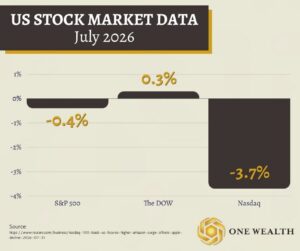
For the month, the market’s three major indices performed as follows:
Dow: +0.3%
S&P 500: −0.4%
Nasdaq Composite: −3.7%
Sources:
https://www.reuters.com/business/nasdaq-100-leads-us-futures-higher-amazon-surge-offsets-apple-decline-2026-07-31
https://www.marketwatch.com/livecoverage/stock-market-today-dow-s-p-500-nasdaq-tech-amazon-apple-earnings-chip-stocks-kospi/card/dow-is-eking-out-a-fourth-straight-monthly-gain-E2uwDNdducCvvsQ1XBfV?
Inflation
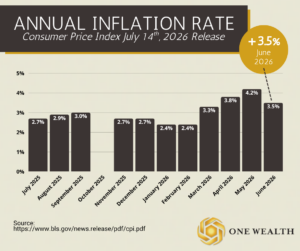
June brought encouraging news on inflation, as the Consumer Price Index (CPI) fell 0.4% on a seasonally adjusted basis—the largest monthly decline since April 2020. On an annual basis, inflation slowed to 3.5%, down from 4.2% in May and below economists’ expectations of 3.8%. Core inflation, which excludes food and energy, was unchanged during the month, lowering the 12-month core inflation rate to 2.6%, also better than forecasts.
The decline was driven primarily by a 5.7% drop in energy prices, including more than 9% declines in gasoline and fuel oil, although energy costs remain 15.7% higher than a year ago. Food prices increased a modest 0.2% during the month and are up 3.0% over the past year, while shelter costs rose just 0.1%, signaling some moderation in one of inflation’s most persistent categories.
While the report offers welcome evidence that inflation pressures may be easing, Federal Reserve officials continue to emphasize that additional months of favorable data will be needed before considering any change in monetary policy. Markets viewed the report positively, but uncertainty remains, particularly as geopolitical events could push energy prices higher again and reignite inflationary pressures.
Sources:
https://www.cnbc.com/2026/07/14/consumer-price-index-inflation-report-june-2026.html
https://www.bls.gov/news.release/cpi.nr0.htm
Jobs & Unemployment
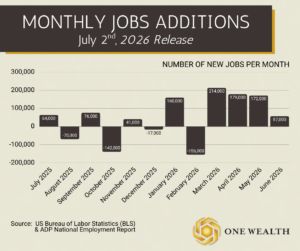
The U.S. labor market showed signs of cooling in June, with employers adding 57,000 nonfarm jobs, well below May’s downwardly revised 129,000 increase and below economists’ expectations. Despite the slower pace of hiring, the unemployment rate held relatively steady at 4.2%, while the labor force participation rate declined to 61.5%, its lowest level since March 2021.
Job gains were led by professional and business services (+36,000), social assistance (+25,000), and health care (+22,000). Meanwhile, the leisure and hospitality sector lost 61,000 jobs, reflecting weaker-than-usual seasonal hiring. Average hourly earnings rose 0.3% in June and were up 3.5% from a year earlier, suggesting wage growth remains stable even as overall hiring has slowed.
Source:
https://www.bls.gov/news.release/pdf/empsit.pdf
https://www.cnbc.com/2026/07/02/jobs-report-june-2026-.html
The FED and Rates
The Federal Reserve voted 9-3 to leave its benchmark interest rate unchanged at 3.5%–3.75%, signaling no immediate change in monetary policy despite growing internal disagreement. While three regional Fed presidents dissented in favor of raising rates by a quarter point because inflation remains above the Fed’s 2% target, Chairman Kevin Warsh and the majority opted to hold rates steady, citing a solid economy and stable labor market while continuing to monitor inflation and broader economic conditions.
The decision keeps borrowing costs unchanged for now, although the unusually strong dissent suggests some policymakers are becoming more concerned that higher rates may eventually be needed if inflation persists.
Sources:
https://www.cnbc.com/2026/07/29/fed-rate-decision-july-2026.html
GDP
The U.S. economy gained momentum in the first quarter of 2026, with real Gross Domestic Product (GDP) increasing at an annualized rate of 2.1%, an improvement from 0.5% growth in the fourth quarter of 2025 and above economists’ expectations. The increase was driven by stronger business investment, exports, government spending, and consumer spending, reflecting broader economic activity across several sectors.
The latest estimate also showed that growth was revised higher from previous reports, while corporate profits increased by $74.4 billion during the quarter. Although inflation remained elevated, the stronger GDP reading suggests the U.S. economy entered 2026 on firmer footing after a slower finish to last year.
Sources:
https://www.bea.gov/news/2026/gdp-third-estimate-industries-corporate-profits-state-gdp-and-state-personal-income-1st
https://www.advisorperspectives.com/dshort/updates/2026/06/25/gdp-gross-domestic-product-q1-2026-third-estimat
Real Estate & Mortgage Market
The U.S. housing market remained constrained in July as elevated prices and borrowing costs continued to weigh on buyers. Existing-home sales fell 2.4% in June to a seasonally adjusted annual rate of 4.09 million, according to the National Association of REALTORS®. Meanwhile, the median existing-home price climbed to a record $440,600, representing a 1.8% increase from one year earlier. These figures reflect housing transactions completed in June and released during July.
Housing inventory has improved, but supply remains relatively limited in many markets. At the end of June, available inventory represented approximately 4.6 months of supply at the current sales pace. Pending home sales also declined 5.4% in June, suggesting that completed sales could remain subdued in the coming months.
Mortgage rates moved higher during July, adding to ongoing affordability challenges. The average rate for a 30-year fixed mortgage reached 6.55% during the week ending July 16, up from 6.43% at the beginning of the month, although it remained below the 6.75% average recorded one year earlier.
Sources:
https://www.nar.realtor/newsroom/nar-existing-home-sales-report-shows-2-4-decrease-in-june
https://www.freddiemac.com/pmms
https://www.reuters.com/markets/wealth/us-pending-home-sales-slump-june-amid-affordability-challenges-2026-07-16/
Notable Quote
“The courage to press on regardless – regardless of whether we face calm seas or rough seas – is the quintessential attribute of the successful investor.”
-John C. Bogle


Stock Market
Wall Street experienced a mixed July as investors navigated corporate earnings, inflation data, and ongoing uncertainty surrounding interest rates. Markets finished the month on a stronger note after solid earnings from several major technology companies helped improve investor confidence.
For the month, the market’s three major indices performed as follows:
Dow: +0.3%
S&P 500: −0.4%
Nasdaq Composite: −3.7%
Sources:
https://www.reuters.com/business/nasdaq-100-leads-us-futures-higher-amazon-surge-offsets-apple-decline-2026-07-31
https://www.marketwatch.com/livecoverage/stock-market-today-dow-s-p-500-nasdaq-tech-amazon-apple-earnings-chip-stocks-kospi/card/dow-is-eking-out-a-fourth-straight-monthly-gain-E2uwDNdducCvvsQ1XBfV?
Inflation
June brought encouraging news on inflation, as the Consumer Price Index (CPI) fell 0.4% on a seasonally adjusted basis—the largest monthly decline since April 2020. On an annual basis, inflation slowed to 3.5%, down from 4.2% in May and below economists’ expectations of 3.8%. Core inflation, which excludes food and energy, was unchanged during the month, lowering the 12-month core inflation rate to 2.6%, also better than forecasts.
The decline was driven primarily by a 5.7% drop in energy prices, including more than 9% declines in gasoline and fuel oil, although energy costs remain 15.7% higher than a year ago. Food prices increased a modest 0.2% during the month and are up 3.0% over the past year, while shelter costs rose just 0.1%, signaling some moderation in one of inflation’s most persistent categories.
While the report offers welcome evidence that inflation pressures may be easing, Federal Reserve officials continue to emphasize that additional months of favorable data will be needed before considering any change in monetary policy. Markets viewed the report positively, but uncertainty remains, particularly as geopolitical events could push energy prices higher again and reignite inflationary pressures.
Sources:
https://www.cnbc.com/2026/07/14/consumer-price-index-inflation-report-june-2026.html
https://www.bls.gov/news.release/cpi.nr0.htm
Jobs & Unemployment
The U.S. labor market showed signs of cooling in June, with employers adding 57,000 nonfarm jobs, well below May’s downwardly revised 129,000 increase and below economists’ expectations. Despite the slower pace of hiring, the unemployment rate held relatively steady at 4.2%, while the labor force participation rate declined to 61.5%, its lowest level since March 2021.
Job gains were led by professional and business services (+36,000), social assistance (+25,000), and health care (+22,000). Meanwhile, the leisure and hospitality sector lost 61,000 jobs, reflecting weaker-than-usual seasonal hiring. Average hourly earnings rose 0.3% in June and were up 3.5% from a year earlier, suggesting wage growth remains stable even as overall hiring has slowed.
Source:
https://www.bls.gov/news.release/pdf/empsit.pdf
https://www.cnbc.com/2026/07/02/jobs-report-june-2026-.html
The FED and Rates
The Federal Reserve voted 9-3 to leave its benchmark interest rate unchanged at 3.5%–3.75%, signaling no immediate change in monetary policy despite growing internal disagreement. While three regional Fed presidents dissented in favor of raising rates by a quarter point because inflation remains above the Fed’s 2% target, Chairman Kevin Warsh and the majority opted to hold rates steady, citing a solid economy and stable labor market while continuing to monitor inflation and broader economic conditions.
The decision keeps borrowing costs unchanged for now, although the unusually strong dissent suggests some policymakers are becoming more concerned that higher rates may eventually be needed if inflation persists.
Sources:
https://www.cnbc.com/2026/07/29/fed-rate-decision-july-2026.html
GDP
The U.S. economy gained momentum in the first quarter of 2026, with real Gross Domestic Product (GDP) increasing at an annualized rate of 2.1%, an improvement from 0.5% growth in the fourth quarter of 2025 and above economists’ expectations. The increase was driven by stronger business investment, exports, government spending, and consumer spending, reflecting broader economic activity across several sectors.
The latest estimate also showed that growth was revised higher from previous reports, while corporate profits increased by $74.4 billion during the quarter. Although inflation remained elevated, the stronger GDP reading suggests the U.S. economy entered 2026 on firmer footing after a slower finish to last year.
Sources:
https://www.bea.gov/news/2026/gdp-third-estimate-industries-corporate-profits-state-gdp-and-state-personal-income-1st
https://www.advisorperspectives.com/dshort/updates/2026/06/25/gdp-gross-domestic-product-q1-2026-third-estimat
Real Estate & Mortgage Market
The U.S. housing market remained constrained in July as elevated prices and borrowing costs continued to weigh on buyers. Existing-home sales fell 2.4% in June to a seasonally adjusted annual rate of 4.09 million, according to the National Association of REALTORS®. Meanwhile, the median existing-home price climbed to a record $440,600, representing a 1.8% increase from one year earlier. These figures reflect housing transactions completed in June and released during July.
Housing inventory has improved, but supply remains relatively limited in many markets. At the end of June, available inventory represented approximately 4.6 months of supply at the current sales pace. Pending home sales also declined 5.4% in June, suggesting that completed sales could remain subdued in the coming months.
Mortgage rates moved higher during July, adding to ongoing affordability challenges. The average rate for a 30-year fixed mortgage reached 6.55% during the week ending July 16, up from 6.43% at the beginning of the month, although it remained below the 6.75% average recorded one year earlier.
Sources:
https://www.nar.realtor/newsroom/nar-existing-home-sales-report-shows-2-4-decrease-in-june
https://www.freddiemac.com/pmms
https://www.reuters.com/markets/wealth/us-pending-home-sales-slump-june-amid-affordability-challenges-2026-07-16/
Notable Quote
“The courage to press on regardless – regardless of whether we face calm seas or rough seas – is the quintessential attribute of the successful investor.”
-John C. Bogle