Stock Market
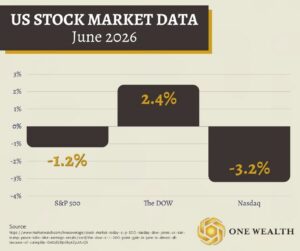
The three major U.S. indexes had a mixed June. The Dow Jones Industrial Average was the lone winner, gaining +2.4% for the month, while the S&P 500 slipped -1.2% and the NASDAQ Composite fell -3.2%, weighed down by weakness in mega-cap technology stocks.
Despite the soft finish to the month, all three indexes posted strong first-half gains. The Dow rose 8.9% in the first six months of 2026 — its best first-half performance since 2021. The S&P 500 climbed 9.6% and the NASDAQ advanced 12.8% over the same period. The small-cap Russell 2000 was the standout, surging nearly 22% for its best first-half performance since 1991.
Much of that first-half strength was concentrated in Q2, which proved to be an exceptional quarter. The S&P 500 and NASDAQ surged 14.9% and 21.4% respectively — their biggest quarterly gains since Q2 2020. The Dow added 12.9% in Q2, its strongest quarter since Q4 2022.
Sources:
https://www.cnbc.com/2026/06/30/stock-market-today-live-updates.htmlhttps://www.reuters.com/business/us-stock-futures-little-changed-strong-quarter-nears-end-2026-06-30/
https://www.marketwatch.com/livecoverage/stock-market-today-s-p-500-nasdaq-dow-jones-us-iran-trump-peace-talks-nike-earnings-results/card/the-dow-s-1-300-point-gain-in-june-is-almost-all-because-of-caterpillar-DeUaELRjn5By6Zp2AuQ5
Inflation
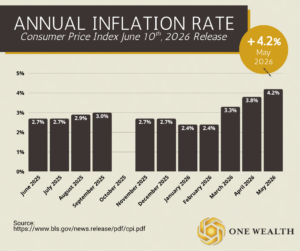
Inflation accelerated in May per the latest data, with the Consumer Price Index (CPI) rising 0.5% for the month and 4.2% over the past 12 months, marking the first time annual inflation has exceeded 4% in three years.
The primary driver was energy costs, which jumped 3.9% in May and are now up 23.5% from a year ago. Energy accounted for more than 60% of the monthly increase in inflation. Food prices rose a modest 0.2% during the month, while shelter costs increased 0.3% and remain up 3.4% year-over-year.
Encouragingly, underlying inflation pressures remained relatively contained. Core inflation, which excludes food and energy, increased just 0.2% in May and 2.9% over the past year. Core commodity prices actually declined 0.1%, suggesting that broader price pressures remain muted despite higher energy costs.
Several categories, including transportation services, motor vehicle insurance, and new vehicles, posted declines, while airline fares, medical care, and recreation costs moved higher. The report suggests that while consumers continue to feel the impact of rising energy and everyday living costs, inflation outside of energy remains comparatively stable.
Sources:
https://www.bls.gov/news.release/cpi.nr0.htm
https://www.cnbc.com/2026/06/10/cpi-inflation-report-may-2026.html
Jobs & Unemployment
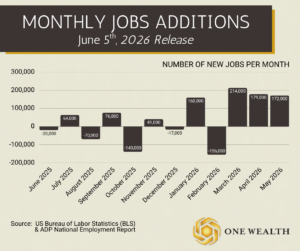
The U.S. labor market remained resilient in May, with employers adding 172,000 jobs – well above expectations of 85,000 – and prior months’ figures revised higher. The unemployment rate held steady at 4.3%, where it has remained within a narrow range for nearly a year.
Hiring was led by leisure and hospitality, health care, and local government, underscoring continued strength in consumer-facing and service-oriented sectors. Labor force participation remained stable at 61.8%, and the number of unemployed workers held near 7.3 million.
While headline employment data points to an economy that remains on solid footing, some underlying trends warrant attention. Long-term unemployment rose by 524,000 over the past year to 2.0 million, representing 27.5% of all unemployed workers, and analysts continue to monitor signs of consumer strain, including lower savings rates and rising delinquencies.
Overall, the May employment report reinforces the view that the U.S. economy continues to expand despite elevated interest rates and lingering concerns about consumer spending.
Source:
https://www.bls.gov/news.release/pdf/empsit.pdf
GDP
The U.S. economy expanded at an annualized rate of 1.6% in the first quarter of 2026, according to the second estimate from the Bureau of Economic Analysis, marking an acceleration from the 0.5% growth recorded in the fourth quarter of 2025. However, the figure was revised down from the initial 2.0% estimate, reflecting weaker-than-expected consumer spending and investment. Growth was supported by exports, government spending, business investment, and consumer spending, while rising imports acted as a drag on overall GDP. Consumer spending, which accounts for more than two-thirds of economic activity, increased at a modest 1.4% annualized pace.
Inflation pressures remained elevated during the quarter, with the Personal Consumption Expenditures (PCE) price index rising 4.5% and core PCE, which excludes food and energy, increasing 4.4%. Meanwhile, a broader measure of domestic demand—real final sales to private domestic purchasers—rose 2.4%, indicating underlying private-sector activity remained relatively solid despite the slower headline growth rate. Real gross domestic income (GDI) increased 0.9%, and the average of GDP and GDI, often viewed as a more comprehensive measure of economic performance, rose 1.3%.
While strong business investment—particularly in equipment spending, which rose 17.2%—continues to be supported by artificial intelligence-related capital expenditures, economists are increasingly cautious about the outlook for the remainder of the year. Slowing consumer momentum, persistent inflation, and rising geopolitical tensions are expected to weigh on economic growth in coming quarters.
Sources:
https://www.bea.gov/news/2026/gdp-second-estimate-and-corporate-profits-1st-quarter-2026
https://www.reuters.com/business/us-first-quarter-gdp-growth-revised-lower-16-pace-2026-05-28/
Real Estate & Mortgage Market
The U.S. housing market continues to show resilience despite affordability challenges. According to the latest Federal Housing Finance Agency (FHFA) data, national home prices rose 1.7% year-over-year in the first quarter of 2026 and 0.5% from the previous quarter. Meanwhile, pending home sales recently climbed to a six-month high, suggesting buyers remain active even as inventory and financing costs continue to influence purchasing decisions.
Mortgage rates remain elevated but have eased slightly in recent weeks. Freddie Mac reports the average 30-year fixed-rate mortgage at 6.47%, down modestly from the prior week but still high enough to affect affordability for many buyers. Higher borrowing costs and elevated home prices continue to slow overall sales activity, although many economists expect demand to improve gradually as inventory expands and rates stabilize.
Sources:
https://www.reuters.com/business/us-pending-home-sales-increase-six-month-high-may-2026-06-17
https://www.fhfa.gov/news/news-release/u.s.-house-prices-rise-1.7-percent-year-over-year-up-0.5-percent-quarter-over-quarter
Notable Quote
“The challenge is not to pick the best investment. The challenge is to pick a sensible investment plan and stick with it.”
-Charles Ellis


Stock Market
The three major U.S. indexes had a mixed June. The Dow Jones Industrial Average was the lone winner, gaining +2.4% for the month, while the S&P 500 slipped -1.2% and the NASDAQ Composite fell -3.2%, weighed down by weakness in mega-cap technology stocks.
Despite the soft finish to the month, all three indexes posted strong first-half gains. The Dow rose 8.9% in the first six months of 2026 — its best first-half performance since 2021. The S&P 500 climbed 9.6% and the NASDAQ advanced 12.8% over the same period. The small-cap Russell 2000 was the standout, surging nearly 22% for its best first-half performance since 1991.
Much of that first-half strength was concentrated in Q2, which proved to be an exceptional quarter. The S&P 500 and NASDAQ surged 14.9% and 21.4% respectively — their biggest quarterly gains since Q2 2020. The Dow added 12.9% in Q2, its strongest quarter since Q4 2022.
Sources:
https://www.cnbc.com/2026/06/30/stock-market-today-live-updates.htmlhttps://www.reuters.com/business/us-stock-futures-little-changed-strong-quarter-nears-end-2026-06-30/
https://www.marketwatch.com/livecoverage/stock-market-today-s-p-500-nasdaq-dow-jones-us-iran-trump-peace-talks-nike-earnings-results/card/the-dow-s-1-300-point-gain-in-june-is-almost-all-because-of-caterpillar-DeUaELRjn5By6Zp2AuQ5
Inflation
Inflation accelerated in May per the latest data, with the Consumer Price Index (CPI) rising 0.5% for the month and 4.2% over the past 12 months, marking the first time annual inflation has exceeded 4% in three years.
The primary driver was energy costs, which jumped 3.9% in May and are now up 23.5% from a year ago. Energy accounted for more than 60% of the monthly increase in inflation. Food prices rose a modest 0.2% during the month, while shelter costs increased 0.3% and remain up 3.4% year-over-year.
Encouragingly, underlying inflation pressures remained relatively contained. Core inflation, which excludes food and energy, increased just 0.2% in May and 2.9% over the past year. Core commodity prices actually declined 0.1%, suggesting that broader price pressures remain muted despite higher energy costs.
Several categories, including transportation services, motor vehicle insurance, and new vehicles, posted declines, while airline fares, medical care, and recreation costs moved higher. The report suggests that while consumers continue to feel the impact of rising energy and everyday living costs, inflation outside of energy remains comparatively stable.
Sources:
https://www.bls.gov/news.release/cpi.nr0.htm
https://www.cnbc.com/2026/06/10/cpi-inflation-report-may-2026.html
Jobs & Unemployment
The U.S. labor market remained resilient in May, with employers adding 172,000 jobs – well above expectations of 85,000 – and prior months’ figures revised higher. The unemployment rate held steady at 4.3%, where it has remained within a narrow range for nearly a year.
Hiring was led by leisure and hospitality, health care, and local government, underscoring continued strength in consumer-facing and service-oriented sectors. Labor force participation remained stable at 61.8%, and the number of unemployed workers held near 7.3 million.
While headline employment data points to an economy that remains on solid footing, some underlying trends warrant attention. Long-term unemployment rose by 524,000 over the past year to 2.0 million, representing 27.5% of all unemployed workers, and analysts continue to monitor signs of consumer strain, including lower savings rates and rising delinquencies.
Overall, the May employment report reinforces the view that the U.S. economy continues to expand despite elevated interest rates and lingering concerns about consumer spending.
Source:
https://www.bls.gov/news.release/pdf/empsit.pdf
GDP
The U.S. economy expanded at an annualized rate of 1.6% in the first quarter of 2026, according to the second estimate from the Bureau of Economic Analysis, marking an acceleration from the 0.5% growth recorded in the fourth quarter of 2025. However, the figure was revised down from the initial 2.0% estimate, reflecting weaker-than-expected consumer spending and investment. Growth was supported by exports, government spending, business investment, and consumer spending, while rising imports acted as a drag on overall GDP. Consumer spending, which accounts for more than two-thirds of economic activity, increased at a modest 1.4% annualized pace.
Inflation pressures remained elevated during the quarter, with the Personal Consumption Expenditures (PCE) price index rising 4.5% and core PCE, which excludes food and energy, increasing 4.4%. Meanwhile, a broader measure of domestic demand—real final sales to private domestic purchasers—rose 2.4%, indicating underlying private-sector activity remained relatively solid despite the slower headline growth rate. Real gross domestic income (GDI) increased 0.9%, and the average of GDP and GDI, often viewed as a more comprehensive measure of economic performance, rose 1.3%.
While strong business investment—particularly in equipment spending, which rose 17.2%—continues to be supported by artificial intelligence-related capital expenditures, economists are increasingly cautious about the outlook for the remainder of the year. Slowing consumer momentum, persistent inflation, and rising geopolitical tensions are expected to weigh on economic growth in coming quarters.
Sources:
https://www.bea.gov/news/2026/gdp-second-estimate-and-corporate-profits-1st-quarter-2026
https://www.reuters.com/business/us-first-quarter-gdp-growth-revised-lower-16-pace-2026-05-28/
Real Estate & Mortgage Market
The U.S. housing market continues to show resilience despite affordability challenges. According to the latest Federal Housing Finance Agency (FHFA) data, national home prices rose 1.7% year-over-year in the first quarter of 2026 and 0.5% from the previous quarter. Meanwhile, pending home sales recently climbed to a six-month high, suggesting buyers remain active even as inventory and financing costs continue to influence purchasing decisions.
Mortgage rates remain elevated but have eased slightly in recent weeks. Freddie Mac reports the average 30-year fixed-rate mortgage at 6.47%, down modestly from the prior week but still high enough to affect affordability for many buyers. Higher borrowing costs and elevated home prices continue to slow overall sales activity, although many economists expect demand to improve gradually as inventory expands and rates stabilize.
Sources:
https://www.reuters.com/business/us-pending-home-sales-increase-six-month-high-may-2026-06-17
https://www.fhfa.gov/news/news-release/u.s.-house-prices-rise-1.7-percent-year-over-year-up-0.5-percent-quarter-over-quarter
Notable Quote
“The challenge is not to pick the best investment. The challenge is to pick a sensible investment plan and stick with it.”
-Charles Ellis